Where Skills Turn Into Independence
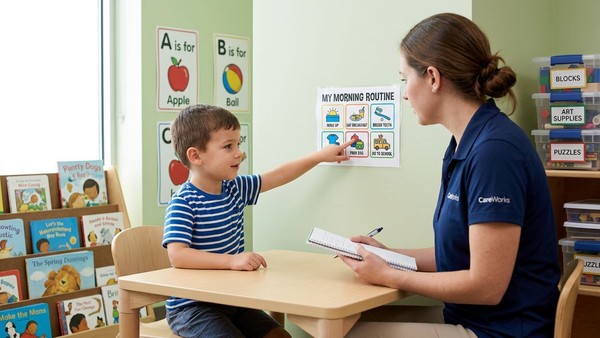
Pathways prepares children ages 4–6 for the real demands of school: sitting through circle time, asking the teacher for help, taking turns at recess, recovering from a transition without melting down. We bridge the years between play-based therapy and the structured day kindergarten will expect.
 The Kindergarten Window
When School-Readiness Either Clicks or Doesn’t
By age four, kindergarten is right around the corner. Your child is being asked to do things every single school day that nobody explicitly teaches: sit through a 20-minute lesson without leaving the carpet, raise a hand and wait to be called on, recognize their own name on a hook, ask the bathroom question without melting down. These are not academic skills. They are the unwritten survival skills of the school day.
Pathways targets exactly those skills. We start with where your child is right now and work backward from the kindergarten classroom they will walk into, building the specific behaviors, language, and routines that turn the school day from a battle into a place they belong. The earlier we build them, the less catch-up your child will need to do once school starts.
Four Capabilities the Kindergarten Day Will Test
Every Pathways plan is individualized, but four capabilities show up in nearly every school-readiness goal set. We work on these in the contexts that match your child’s day, not in abstract drills.
Following the Teacher’s Voice
- Asking the teacher for help with words
- Answering a question when called on
- Following multi-step group instructions
- Joining a back-and-forth conversation
Friendships Worth Keeping
- Greeting peers in the morning
- Joining a game already in progress
- Sharing materials at the worktable
- Recognizing when a friend is upset
The Things Kindergarten Doesn’t Teach
- Lining up and walking with a class
- Raising a hand and waiting to be called
- Putting belongings in the right cubby
- Knowing when to ask for the bathroom
Independence That Travels
- Managing toileting at school
- Handling lunchtime routines
- Recovering from a hard moment alone
- Following the schedule without an adult prompt
Help Your Child Discover New Pathways
The kindergarten window is open now. A right-sized plan starts here.
Small Gaps at 4 Become Big Gaps at 7
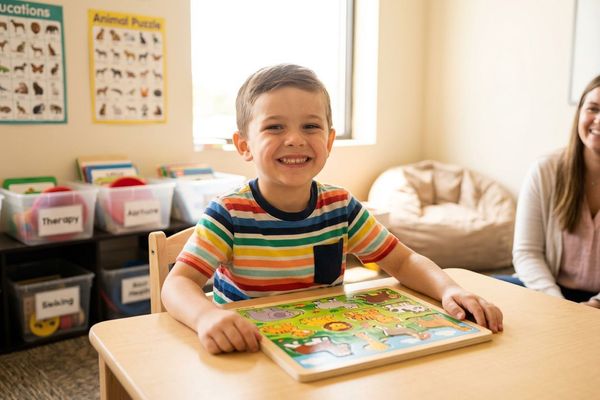
A six-month communication delay at age 4 looks small in a quiet living room. Once school starts, that same gap stretches into a year, then two. The kindergartener who cannot ask for the bathroom misses content. The first-grader who cannot regulate frustration loses friendships. By second grade, a small early gap can become a wide academic and social one, much harder to close.
Pathways exists in the years where intervention still acts on a steep curve. The same hour of structured ABA does more work at age 5 than it does at age 9 because the developmental terrain is still moving. Use that window.
Catch the delay before the cohort moves on
Targeted school-readiness programming before kindergarten gives your child the runway peers got organically.
Accelerate development on a steep curve
The 4-6 brain still rewires fast. Skills installed now stick harder than the same skills installed at 9 or 10.
Walk in ready, not behind
Children who arrive at kindergarten ready for the day spend the year learning. Children who arrive behind spend the year catching up.
If your child is graduating from Foundations, Pathways is the natural next chapter. If your child is heading into Confidence (ages 7-12) with stubborn gaps, a Pathways block first can rebuild the foundation school assumed was already there.
You Are the Expert on Your Kindergartener
Therapy hours are valuable, but they are also a small slice of a 4-to-6-year-old’s week. The morning rush, the after-school crash, the homework battle, and the bedtime negotiation all happen with you. Pathways treats the parent as a co-clinician, not an audience.
Your child’s BCBA builds your coaching plan alongside your child’s treatment plan. You leave each conversation with specific scripts, not vague advice.
Weekly parent-coaching sessions
A standing block with your BCBA to review the week, troubleshoot what is not working at home, and align next week’s targets.
Real-time progress visibility
You see what your child worked on, what stuck, and what is next, the same way the clinical team does.
Specific scripts for the hard moments
The exact words for the morning rush, the after-school crash, the lunch packing standoff. Real strategies you can use the next day, not generic positive-parenting tips.
School-team coordination
With your permission, your BCBA can join IEP meetings, observe in the classroom, and align Pathways goals with what the school is asking your child to do every day.
Want a deeper look at our caregiver coaching approach? See the dedicated Parent Training program, which can run alongside Pathways or stand on its own.

Questions Parents Ask Before Kindergarten
The 4-6 window comes with a specific set of decisions: school choice, assessment timing, IEP coordination, and whether to delay kindergarten. Here is what we hear most.
Yes. Pathways is built specifically for the 4-6 window, which is when most children are already in preschool, pre-K, or transitioning into kindergarten. We coordinate with your child’s current school or future kindergarten so that therapy goals and classroom expectations reinforce each other instead of competing. Families starting kindergarten in the fall often use a summer Pathways block to dramatically smooth the transition.
With your written permission, your BCBA can communicate directly with your child’s teacher or IEP team, share treatment goals, and align strategies. We can attend IEP meetings as an advocate for your family, observe in the classroom where allowed, and adjust the Pathways plan to match the specific demands your child is being asked to meet at school every day.
Pathways IS the next chapter for many children who started in Foundations. The clinical relationship and evidence base stay the same. The goals shift from foundational developmental skills to school-readiness, peer interaction, and independence in classroom-style settings. Your same BCBA team usually continues with you through the transition, so there is no clinical reset.
Pathways is comprehensive private ABA, designed around your child’s individual goals at the intensity their plan needs. School-based ABA is one component of an IEP delivered inside the public-school system, usually limited in hours and integrated with other school-day services. Most Pathways families use both: private ABA for intensive skill-building plus school-based supports for the academic day. Our team helps you understand the difference and how to combine them effectively.
The intensity and rhythm shift across the age range. A 4-year-old in Pathways often does 20-25 hours per week, mostly in 2-3 hour structured blocks blending play-based learning with circle-time-style routines. A 6-year-old, especially one in school during the day, often does 10-15 hours per week scheduled after school and on weekends, focused on the specific skills the school day exposes as gaps.
Yes. This is one of the most common questions we get from Pathways families. Your BCBA can run a school-readiness assessment that evaluates your child’s actual K-skill profile against grade-level expectations. We give you a clear, evidence-based picture of where your child is strong and where the gaps are, so you and your school district can make the right call together. Many families find that a structured 8-12 week Pathways block before a planned K start gives the child the best shot at a successful first year.
Build the Skills Kindergarten Will Ask For
Sitting, sharing, following two-step directions, asking for help. We bridge the gap between play-based therapy and the structured day school will expect.