You Are Your Child’s MostPowerful Therapist
Therapy sessions are only a fraction of your child’s waking hours. CareWorks gives you the hands-on coaching and evidence-based strategies to turn every mealtime, car ride, and bedtime into a moment that moves the needle.
One-on-One Coaching Built Around Your Family
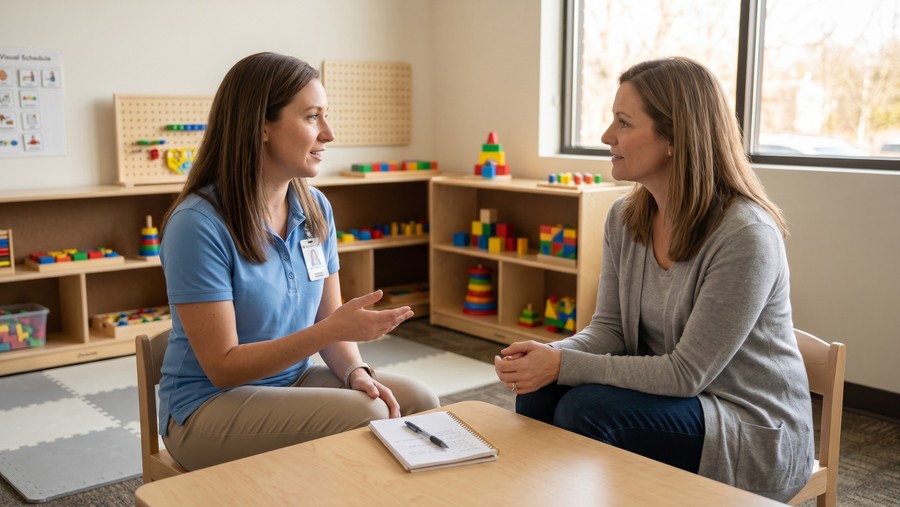
Parent training at CareWorks is not a group workshop, a webinar series, or a one-size-fits-all curriculum. It is a personalized coaching program led by your child’s own Board Certified Behavior Analyst, tailored to your child’s treatment plan, your family’s daily routines, and the specific challenges you face right now.
Caregiver coaching is an essential component of your child’s overall ABA therapy program, not an optional add-on. It is included in your child’s authorized treatment plan and is covered by most insurance providers in Virginia, North Carolina, and New Jersey. Sessions typically occur one to four times per month depending on your child’s needs and your insurance authorization, and they can take place in your home, at one of our therapy centers, or via telehealth for scheduling flexibility.
The goal is simple: to ensure that the strategies your child practices during therapy sessions are reinforced across every setting. When parents, grandparents, and other caregivers respond to behaviors the same way the therapy team does, children generalize new skills faster and maintain them longer. This consistency marks the difference between progress that plateaus and progress that compounds.

Skills You Will Use Every Single Day
Every strategy is taught in the context of your family’s real situations. These are practical, evidence-based techniques you can put to work the same day you learn them.
Positive Reinforcement
Learn how to identify and deliver meaningful reinforcers that motivate your child to engage in desired behaviors. Understand the difference between bribery and reinforcement, and discover how to build motivation systems that work naturally within your daily routine without creating dependency on tangible rewards.
Functional Communication Training
Many challenging behaviors stem from your child’s inability to communicate their needs. FCT teaches you how to recognize communication attempts, honor those attempts consistently, and provide appropriate alternative ways for your child to express what they want, whether through words, signs, pictures, or devices.
Antecedent Strategies
Prevention is more effective than reaction. Learn how to modify the environment, adjust your language, and structure transitions to reduce the likelihood of challenging behaviors before they start. Antecedent strategies empower you to proactively set your child up for success rather than constantly responding to crises.
De-Escalation Techniques
When emotions escalate, parents often feel helpless. Your BCBA will teach you calm, consistent de-escalation strategies that keep both you and your child safe during meltdowns. You will learn to recognize the early warning signs of escalation and intervene before a situation reaches its peak.
Visual Schedules & Routines
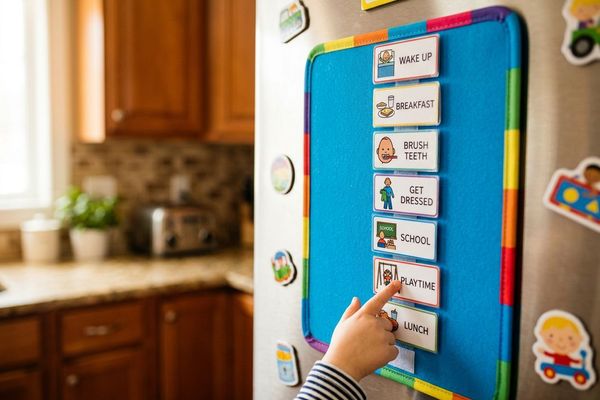
Children with autism often thrive on predictability. Your BCBA will help you create visual schedules, first-then boards, and structured routines tailored to your home. These tools reduce anxiety around transitions, increase independence with daily tasks, and give your child a sense of control over their environment.
Understanding Behavior Function
Every behavior serves a purpose. Your BCBA will teach you the ABCs of behavior analysis: Antecedent (what happens before), Behavior (what the child does), and Consequence (what happens after). Understanding why your child engages in a specific behavior is the key to replacing it with a healthier, more functional alternative.
You Don’t Have to Wait for Therapy to Start to Build Skills.
Coaching can begin the moment authorization is in place, even before your child’s first ABA session.
The 75% Rule: Why Your Role Changes Everything
Research shows that children whose parents receive structured caregiver training make 30 to 50 percent faster progress toward their treatment goals compared to children who receive direct therapy alone. The reason is simple math. Even an intensive ABA program provides approximately 25 hours of therapy per week. But your child is awake roughly 100 hours per week. That means 75 percent of your child’s learning opportunities happen outside of therapy sessions: in your home, your car, the grocery store, and the playground.
When you know how to respond to your child’s behaviors consistently, use reinforcement effectively, and create structured learning opportunities throughout the day, you multiply the impact of every formal therapy session. Parent consistency across settings is the single most powerful accelerator of therapeutic progress.
30
Faster Progress Toward Goals
0
Of Learning Happens Outside Therapy
From Meltdowns to Milestones: Real Strategies for Real Life
Strategy only matters when it works in your kitchen, your car, and the grocery store. Here are real scenarios where parent training makes an immediate, tangible difference in your family’s daily life.
Mealtimes
The challenge: Your child only eats three foods, throws utensils, and melts down when presented with new foods on their plate.
The strategy: Gradual food exposure using a hierarchy: tolerate on plate, touch, smell, taste, pairing new foods with preferred items, reinforcing any attempt at interaction with new foods, and removing pressure to eat. Your BCBA will build a desensitization plan specific to your child’s sensory profile.
Transitions
The challenge: Leaving the park, turning off the tablet, or switching from playtime to bath time triggers screaming, crying, or physical resistance every single time.
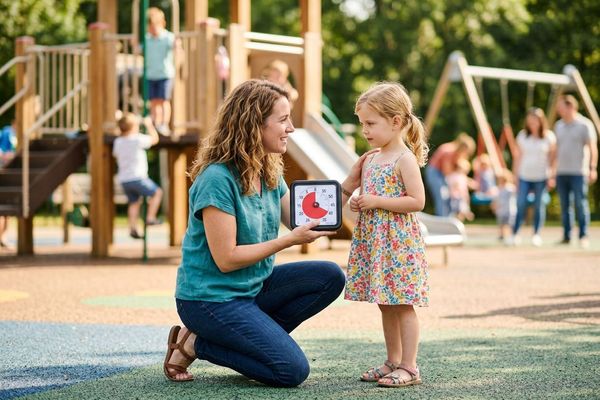
The strategy: Visual countdown timers, verbal and visual warnings at 5, 2, and 1 minute intervals, offering a preferred activity immediately after the transition, and building “transition tokens” that reward smooth transitions. Predictability is the antidote to transition-related distress.
Public Outings
The challenge: Grocery store trips end in meltdowns. Restaurant visits are impossible. You have stopped taking your child to public places because it is too stressful.
The strategy: Gradual exposure with social stories beforehand, bringing preferred items for comfort, practicing short outings before attempting long ones, and using first-then boards (“First we shop, then we go to the car for crackers”). Your BCBA will help you build a systematic desensitization plan for each specific outing.
Sibling Conflicts
The challenge: Sharing toys leads to aggression. Siblings feel ignored because so much attention goes to therapy and behavior management. Resentment is building.
The strategy: Teaching turn-taking with visual timers, setting up structured shared activities that play to both children’s strengths, reinforcing cooperative play, and carving out dedicated one-on-one time with each child. Sibling-inclusive training ensures the whole family benefits from the strategies you learn.
Morning Routines
The challenge: Getting dressed, brushing teeth, eating breakfast, and getting out the door on time feels impossible. Every step is a battle. You are exhausted before the day even starts.
The strategy: A visual morning routine board placed at your child’s eye level, breaking each task into smaller sub-steps, using a token economy where completing each step earns a star toward a preferred morning activity, and preparing the night before to reduce time pressure. Structure and predictability transform chaotic mornings into manageable ones.
These are just a few examples. Your BCBA will address the specific situations your family faces most. Whether it is bedtime resistance, haircuts, doctor visits, or holiday gatherings, there is a strategy for every scenario. Contact us to learn more about how parent training fits into your child’s treatment plan.
We Teach You by Doing, Not Just Telling
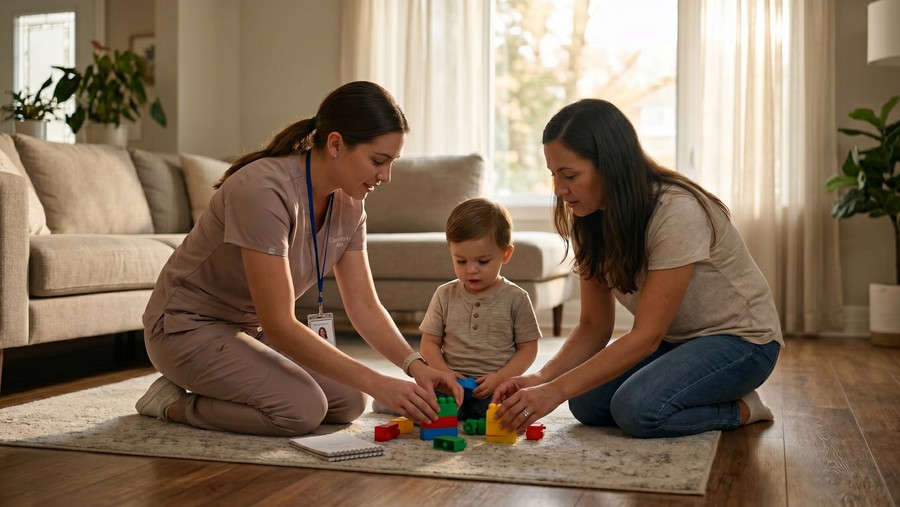
Our caregiver coaching program is built on Behavioral Skills Training (BST), a four-step model with decades of research behind it. BST is not a lecture. It is a hands-on, practice-based method that ensures you can implement every strategy confidently and independently, not just understand it in theory.
Instruction
Your BCBA explains the strategy in clear, jargon-free language. They describe when to use it, why it works, and what to expect. You receive written materials to reference later.
Demonstration
Your BCBA models the strategy in real time, either with your child directly or through role-play. You see exactly what it looks like in practice, not just in theory.
Rehearsal
You practice the strategy yourself while your BCBA observes. This is the most important step. You build muscle memory and confidence by doing, not just watching.
Feedback
Your BCBA provides specific, constructive feedback on what you did well and what to adjust. This iterative coaching cycle continues until you feel comfortable implementing the strategy independently.
Research published in the Journal of Applied Behavior Analysis consistently demonstrates that BST produces high levels of skill acquisition and maintenance in caregivers across diverse populations and settings. When parents are trained using this model, treatment fidelity at home increases dramatically, and children’s outcomes improve correspondingly. Learn more about our full range of services and how parent training integrates with daily therapy.
What Parents Ask About Caregiver Coaching
Questions about how it works, what to expect, and whether insurance covers it. Here are the ones we hear most often.
Your child’s BCBA determines the frequency of caregiver coaching sessions based on clinical need and your insurance authorization. Most families participate in one to four parent training sessions per month, each lasting 60 to 90 minutes. Sessions are scheduled around your availability and can take place in your home, at one of our therapy centers, or via telehealth. During periods of active behavior challenges, transitions (starting school, moving, new sibling), or when introducing new strategies, your BCBA may recommend more frequent sessions. As you become more confident and proficient, the frequency may decrease to a maintenance level.
While it is not required that both parents attend every session, we strongly encourage it whenever possible. Consistency between caregivers is one of the most critical factors in your child’s progress. When both parents use the same strategies, respond to behaviors the same way, and reinforce the same expectations, children learn faster and experience less confusion. If both parents cannot attend simultaneously, your BCBA can alternate between working with each parent individually, ensuring everyone is aligned. We also welcome step-parents, live-in partners, and any other adults who play a significant role in your child’s daily life.
This happens more often than you might think, and it does not mean you are doing anything wrong. Behavioral strategies sometimes produce an “extinction burst” where the challenging behavior temporarily increases before it decreases, because your child is testing whether the old behavior will still work. Your BCBA will prepare you for this possibility in advance. If a strategy is not producing the expected results after a reasonable implementation period, your BCBA will troubleshoot with you. They may observe you implementing the strategy in real time, adjust the approach based on new data, or explore whether the behavior’s function has changed. The coaching relationship is iterative: your BCBA adjusts the plan based on what is actually happening in your home, not just what should happen in theory.
Yes. Parent training and caregiver coaching are recognized as a medically necessary component of ABA therapy by virtually all major insurance providers. The CPT code used for parent training (97156) is a standard part of ABA treatment authorizations. In Virginia, North Carolina, and New Jersey, insurance mandates require coverage for ABA services, which includes caregiver coaching. CareWorks handles all insurance verification and prior authorization on your behalf. The number of parent training hours authorized will depend on your specific plan and your child’s clinical needs, but our team ensures you receive the maximum benefit available under your policy.
Absolutely, and we actively encourage it. Anyone who spends significant time with your child benefits from understanding and implementing the strategies in their treatment plan. Grandparents, nannies, babysitters, older siblings, and daycare providers can all participate in caregiver coaching sessions. The more adults in your child’s life who respond to behaviors consistently and use the same reinforcement strategies, the faster your child will generalize their new skills across all settings and relationships. Your BCBA can tailor individual sessions for different caregivers based on their specific interactions with your child.
Many families report noticeable changes in household dynamics within the first two to four weeks of consistently implementing the strategies they learn in caregiver coaching. Simple adjustments like using visual schedules, providing transition warnings, and delivering reinforcement consistently can produce immediate improvements in cooperation and reduce daily stress. More complex behavioral challenges, such as aggression, self-injury, or severe rigidity, typically require two to three months of consistent strategy use before significant, sustained change is evident. Your BCBA will set realistic expectations based on your child’s specific goals and help you track progress through data so you can see the improvements objectively, even when day-to-day variation makes it hard to notice the trend.
Become the Multiplier in Your Child’s Progress
Your BCBA teaches you the same strategies our clinicians use, so progress continues in every mealtime, bedtime, and transition.