Where Structure Meets Breakthrough
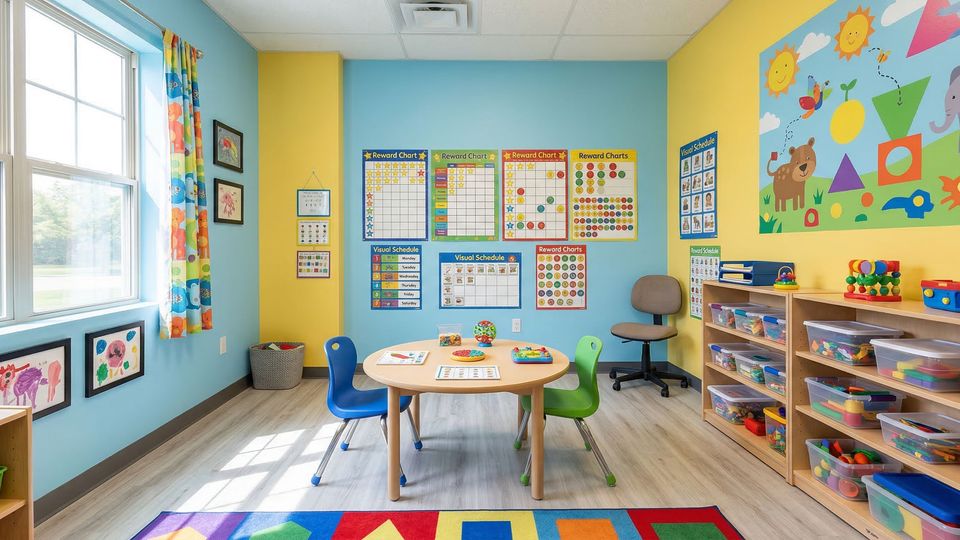
Our centers are intentional environments designed to help children on the autism spectrum build communication, social, and daily living skills through structured, evidence-based therapy. Every square foot, from sensory rooms to group activity areas, supports your child’s growth.
Why Families Choose Center-Based Care
Clinical intensity and natural learning opportunities work together in our centers to accelerate your child’s progress across every developmental domain.
Peer Socialization
Your child interacts with same-age peers throughout the day during group activities, structured play, and mealtimes. These organic social opportunities build turn-taking, shared attention, and communication skills in ways that one-on-one therapy alone cannot replicate.
Structured Environment
Every element of our centers is designed with intention. Distraction-free therapy rooms, visual schedules, and predictable routines help children focus, reduce anxiety, and learn more efficiently than they would in uncontrolled settings.
School Readiness
The center environment closely mirrors a classroom setting, helping your child practice sitting at a table, following group instructions, transitioning between activities, and navigating shared spaces, all critical pre-academic skills.
Specialized Equipment
Our centers feature sensory gyms, fine motor stations, communication devices, visual schedule systems, and adaptive technology that support targeted skill acquisition. This equipment is maintained and updated by our clinical team to meet current evidence-based standards.
Team Collaboration
Your child’s BCBA, RBT, and the entire clinical team work in close proximity, enabling real-time supervision, immediate feedback, and seamless coordination. This collaborative model means treatment adjustments happen faster and more effectively.
Sensory Integration
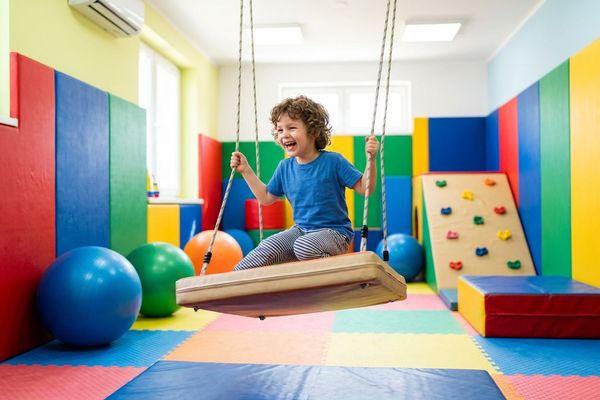
Dedicated sensory rooms with swings, weighted blankets, tactile stations, and calming spaces help children regulate their sensory systems throughout the day. Sensory breaks are woven into the daily schedule to support focus and reduce overstimulation.
Wondering How Many Center Hours Your Child Actually Needs?
Hours per week is the lever that drives outcomes the most. A short BCBA call turns CASP guidelines into a real number for your child.
What a Typical Day Looks Like
Every day at a CareWorks center follows a consistent, predictable rhythm that reduces anxiety and maximizes learning. While each child’s individual schedule is tailored to their treatment plan, here is what a typical day looks like for most of our learners.
Arrival & Welcome
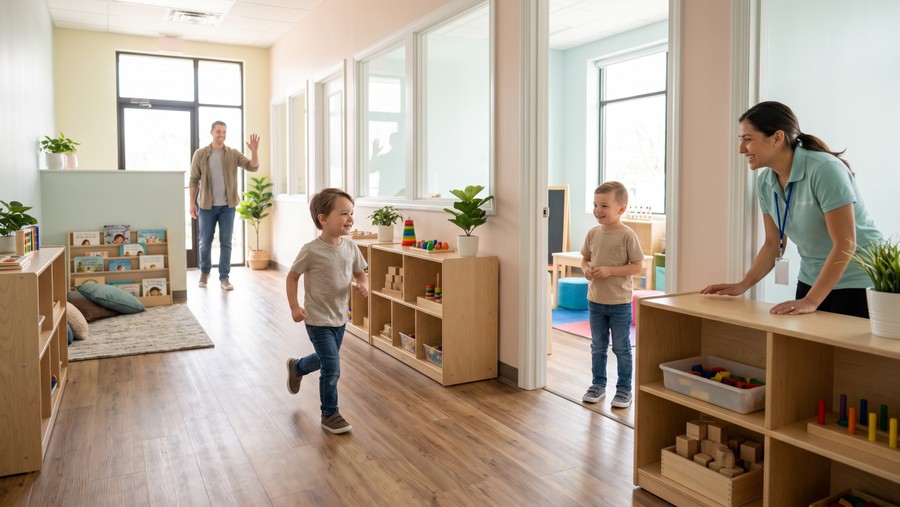
Parents drop off their child each morning at the center entrance. A familiar RBT greets your child by name and guides them through the arrival routine: hanging up their backpack, checking the visual schedule, and transitioning into a preferred warm-up activity. This predictable start builds security and sets a positive tone for the entire day.
1:1 Discrete Trial Sessions
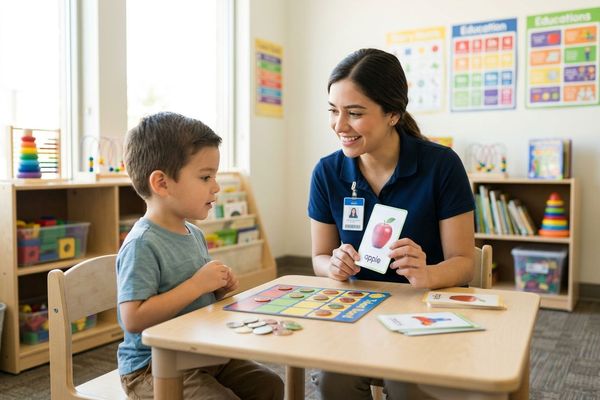
Your child works one-on-one with their RBT in a dedicated therapy room, targeting specific goals from their individualized treatment plan. Sessions use discrete trial training, natural environment teaching, and task analysis techniques. Every response is recorded for data analysis, ensuring measurable progress toward each objective.
Group Social Activities
Throughout the day, children participate in facilitated group activities with their peers. These sessions target social communication, cooperative play, turn-taking, and shared attention in a naturalistic setting. A BCBA oversees these groups to ensure each child receives the appropriate level of prompting and reinforcement.
Sensory Breaks
Scheduled sensory breaks allow children to regulate their nervous systems using our purpose-built sensory rooms. Swings, trampolines, weighted blankets, and tactile stations help children decompress between intensive learning blocks, improving focus and reducing challenging behaviors throughout the day.
Structured Play & Practice
Afternoon sessions blend structured play with naturalistic teaching opportunities. Children practice requesting, labeling, and conversational skills during snack time, art activities, and outdoor play. These functional contexts make learning feel effortless while reinforcing skills across multiple environments within the center.
Parent Pickup & Debrief
At the end of each day, parents receive a brief verbal update or written session summary from their child’s RBT. Your BCBA schedules regular parent meetings to review data, discuss progress, and adjust goals. We want you to feel connected and informed about every aspect of your child’s therapy experience.
Center-Based Session Options
Centers in Suffolk, VA and Greensboro, NC. NJ families receive in-home services.

Why Peer Interaction Changes Everything
The biggest advantage of center-based care is something no other setting can replicate: constant access to peers. Social skills cannot be taught in isolation. Children need real peers, real situations, and real-time guidance to develop meaningful social competence.
At our CareWorks centers, your child engages in facilitated group activities where a BCBA or experienced RBT provides prompting, modeling, and reinforcement for social behaviors as they happen. Your child practices initiating conversations, responding to peers, sharing materials, waiting their turn, reading facial expressions, and navigating the complex dynamics of cooperative play. These are not simulated scenarios; they are authentic social interactions with other children who are also building their skills.
We use structured social skills groups, incidental teaching during free play, peer-mediated interventions, and video modeling to help children generalize their social abilities. Over time, children who participate in our center-based program develop the confidence and competence they need to interact successfully with peers at school, in the community, and at home with siblings. If your child struggles with social engagement, the center-based model offers an unparalleled environment for growth. Learn more about our full range of therapy services.
Is Center-Based Autism Care Right for Your Child?
Center-based therapy is built for children who need what a home environment can’t provide: daily access to same-age peers, structured transitions that mirror a classroom, sensory equipment designed for regulation, and a clinical team working in close proximity for real-time adjustments.
Children who thrive in our centers typically:
Some families start center-based and add in-home sessions to reinforce routines at home. Others start at home and transition to the center once their child is ready for peer interaction. Your BCBA maps this out during the initial assessment.
What Parents Ask About Center-Based Care
Thinking about center-based care? Here are the questions families ask most often before getting started.
Our center-based program serves children from 3 years through 12 years of age. Our curriculum addresses the developmental milestones of preschoolers and school-aged children, providing a structured environment that mimics many aspects of a classroom while delivering intensive 1:1 behavioral support. The exact age range may vary slightly by location, and older children or adolescents may be better served through our in-home program. During the initial assessment, your BCBA will recommend the most appropriate service model based on your child’s age, developmental level, and clinical needs.
Center-based therapy at CareWorks typically ranges from three to eight hours per day, depending on your child’s treatment plan and insurance authorization. Full-day programs run five to eight hours and are recommended for children who require intensive services (25 to 40 hours per week). Half-day programs of three to four hours are available for children who need fewer hours or who attend school part of the day. We also offer after-school programming of two to three hours for school-aged children. Your BCBA determines the optimal daily schedule based on clinical need, and our care coordinators work with your insurance to authorize the appropriate number of hours.
A typical center-based session alternates between structured one-on-one teaching with your child’s RBT, group social activities with peers, sensory and movement breaks, and naturalistic play-based learning. Sessions begin with a warm-up activity to help your child transition into the therapy environment and end with a wrap-up and parent update. Throughout the day, your child’s RBT collects data on every targeted skill to track progress. The specific activities and skill targets are determined by your child’s individualized treatment plan and supervised directly by a BCBA who is present on-site. Learn more about how our therapy process works.
Yes. We believe in full transparency and encourage parent involvement. Many of our centers offer observation windows or designated viewing areas where parents can watch sessions without disrupting the therapy flow. We also schedule regular parent observation days and caregiver training sessions where your BCBA walks you through the techniques being used so you can reinforce them at home. Parents receive detailed session notes and regular progress meetings to stay fully informed about their child’s development. If you have questions about observation options at a specific location, contact our care team.
While center-based therapy may look similar to a daycare or preschool from the outside, it is fundamentally different in every meaningful way. Applied Behavior Analysis is a medical treatment prescribed and supervised by a Board Certified Behavior Analyst. Every activity during the day clinically targets specific goals from your child’s individualized treatment plan. Your child receives dedicated one-on-one attention from a trained Registered Behavior Technician, and every interaction produces measurable data that informs ongoing treatment decisions. Group activities are therapeutically facilitated to build specific social skills, not simply for childcare purposes. Center-based care is a clinical intervention, not a school or daycare replacement.
Yes. CareWorks offers after-school center-based therapy for children who attend school during the day and need continued support in the afternoon. After-school sessions typically run two to three hours and focus on skill areas that complement what your child is learning in the classroom, including social skills, homework routines, self-regulation, and daily living skills. This option is ideal for families who want to maintain therapeutic intensity without pulling their child out of school. After-school availability may vary by location, so contact our team to discuss scheduling at your nearest center.
A Dedicated Space Built for Breakthroughs
Center-based therapy takes place in a dedicated clinical facility specifically designed for children with autism spectrum disorder. Unlike in-home therapy, which occurs in your family’s natural environment, center-based programs bring your child into a structured space equipped with specialized tools, sensory integration areas, and opportunities for peer interaction that simply cannot be replicated at home.
At CareWorks, children work one-on-one with a Registered Behavior Technician under the supervision of a Board Certified Behavior Analyst during each session. The center-based model is particularly helpful to children who need practice with intensive social skills around peers or require access to specialized equipment like sensory gyms, structured work stations, and communication technology that may not be available at home.
This program is ideal for families who want their child immersed in a therapeutic learning environment for several hours each day, with built-in opportunities for group activities, natural socialization, and structured transitions that mirror what they will encounter in school settings. Many families choose center-based therapy as their primary service model, while others combine it with in-home sessions to ensure skills generalize across settings.
See the Space Where Your Child Will Thrive
Our Suffolk and Greensboro centers are purpose-built for breakthroughs. Schedule a tour and see it yourself before you commit.