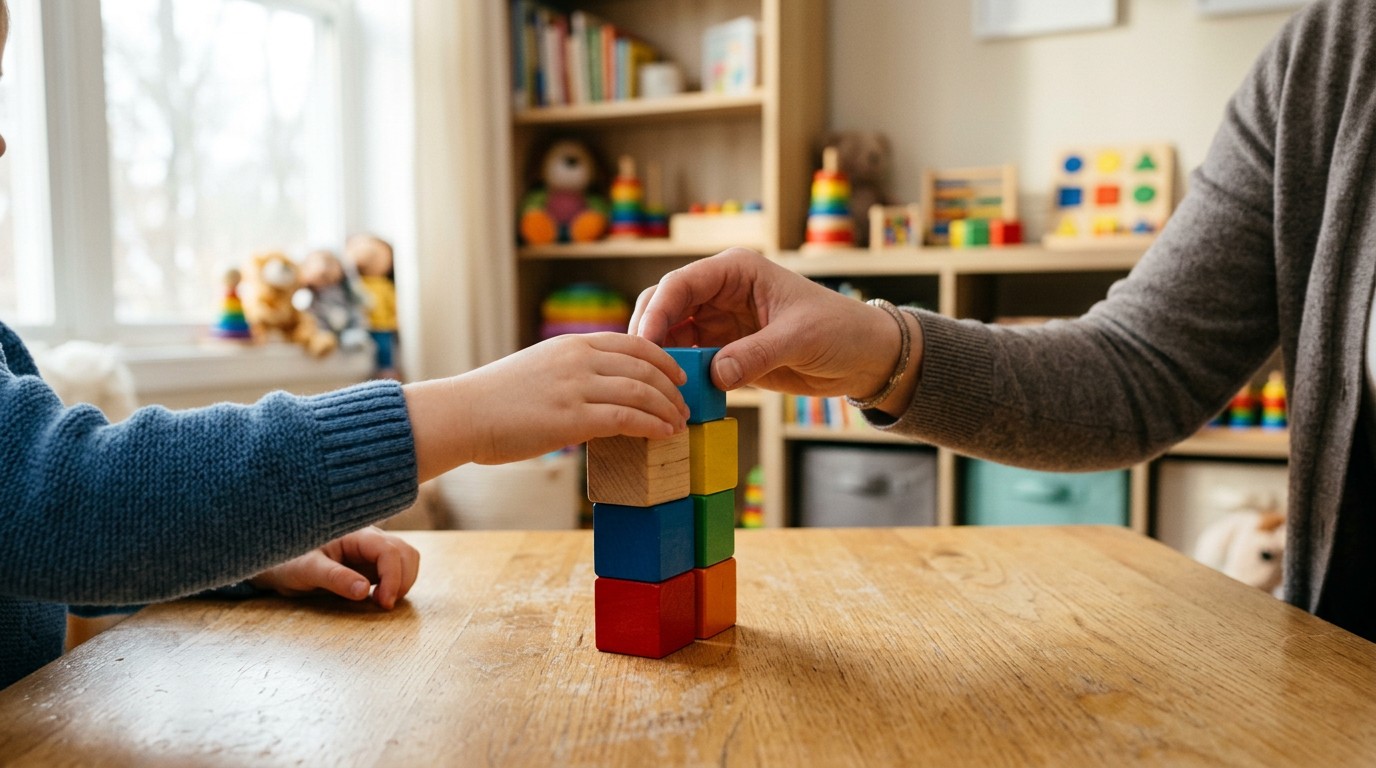
Most families notice the first small changes within a few weeks of starting ABA, see clearer skill gains somewhere in the three-to-six-month range, and watch the bigger developmental shifts build across one to two years. Those windows are averages, and your child may move through any of them faster or slower. Early wins tend to be quiet ones: a new word, a calmer drop-off, a point at the fridge instead of a meltdown. The larger goals, like back-and-forth conversation or getting dressed independently, take longer because they’re assembled from dozens of smaller skills stacked on top of each other.
Key Takeaways
- First visible changes often appear in the first four to eight weeks, and they’re usually small and behavioral.
- Meaningful skill gains build over months, and research has not found that more weekly hours reliably speed them up.
- There’s no fixed timeline. Starting point, hours, profile, and home carryover all move the needle.
- Your BCBA tracks progress with session-by-session data, so you don’t have to rely on gut feel.
- Slow-feeling stretches are normal, though a genuine plateau is worth a conversation.
How Long Does ABA Therapy Take to Show Results?
Honest answer: it depends on what you’re counting as a result. If you’re watching for your child to tolerate a new therapist and settle into sessions, that’s usually weeks. If you’re watching for a skill that holds up at home, at Grandma’s, and at the grocery store, that’s months. The outcomes that shift a child’s trajectory get measured in years.
The research reflects that spread. A 2018 Cochrane review by Reichow and colleagues pooled studies of early intensive behavioral intervention and found an average gain of about 9.6 points on the Vineland adaptive behavior scales, the review’s primary outcome, along with a secondary gain of about 15.4 IQ points. Worth knowing as a parent: the review graded that evidence as low quality, because the studies were small and most were not randomized. The direction is encouraging and the precision isn’t there yet. Anyone handing you a guaranteed number of months is telling you something the science doesn’t support.
Why There’s No One-Size-Fits-All Timeline
Two four-year-olds with the same diagnosis can walk into the same clinic with completely different starting skills, sensory profiles, sleep patterns, and communication systems. One might already imitate sounds, which gives a therapist a foothold for vocal language within weeks. Another might need three months of work on joint attention before language goals make sense at all. The CDC’s guidance on autism treatment makes the same point: autistic people have distinct strengths and challenges, and plans get built around the individual.
This is also why comparing your child to the kid in the waiting room will make you miserable and won’t tell you anything useful. Their goals aren’t your goals. Their baseline wasn’t your baseline.
What “Results” Actually Means in ABA
In ABA, a result is a measurable skill that shows up reliably, and then shows up in places it wasn’t taught. That last part is called generalization, and it’s the difference between a child who can name a picture of a cup and a child who asks for water when they’re thirsty in a friend’s kitchen. Generalization is the whole point, and it’s slower than acquisition, which is one reason progress can feel underwhelming right when it’s going well.
Results also include the things nobody puts on a certificate. Fewer injuries. A haircut that doesn’t end in tears. A parent who can take both kids to Target. Those count, and they often arrive before the academic gains do. CareWorks walks through what the research on ABA actually shows, including where the evidence is strong and where it’s still thin.
What the First Few Weeks of ABA Look Like
The opening stretch looks, to a lot of parents, like your child is playing while somebody takes notes. That’s roughly accurate, and it’s deliberate. This phase is called pairing, and the therapist’s job is to become associated with good things so your child actually wants them around. A child who’s braced for demands doesn’t learn. A child who’s relaxed does.
Underneath the play, your BCBA is collecting baseline data, the measurement of where each targeted skill sits before treatment starts. Without a baseline, nobody can prove anything worked later. It’s unglamorous and it’s the foundation of every progress report you’ll get for the next two years.
What you might reasonably see in weeks one through eight: your child stops protesting at the door, tolerates sitting near the therapist, hands over an item when asked, or produces one new sound or sign. Small. Real. If you’re seeing nothing at all by week eight, that’s a fair thing to raise, and a good clinician will welcome the question.
How Progress Builds From Month One Through Month Six
This is the window where families in Norfolk, Virginia Beach, and Chesapeake most often tell us something clicked. It usually arrives quietly. You look up in month four and realize mornings have gotten easier, and you can’t pinpoint when that happened.
Communication and Language Gains
Communication tends to move first, because it’s the skill that unlocks the others. That might be spoken words, a picture exchange system, a speech device, or reliable signing. All of it counts, and pushing a child toward speech they aren’t ready for tends to backfire. Autism Speaks’ overview of applied behavior analysis describes the mechanism plainly: skills get broken into steps, reinforced when they occur, and tracked so the plan can change when the data says it should.
The practical version in month three looks like this. Your child wants the tablet. Instead of screaming at the shelf, they pull your hand toward it, or hand you a card, or say “ta.” That’s a request replacing a behavior, and it’s one of the more reliable early indicators that the plan is working.
Daily Living and Behavior Shifts
Daily living skills tend to follow: hand washing, using a spoon, sitting for two minutes at a table, stepping into the bath without a fight. Challenging behavior often drops in the same stretch, usually because the child now has a way to get the same result without it. Behavior that works doesn’t disappear. It gets replaced by something that works better and costs less.
Expect unevenness. Language can sprint while toileting sits still for four months. That’s normal, and it doesn’t mean the plan is broken.
What Affects How Fast Your Child Progresses
Therapy Hours per Week
How many hours, and for how long, are the two questions almost every parent asks. On intensity, the most reliable research offers a reassuring answer: more hours has not been shown to reliably mean faster progress. A 2021 multisite randomized trial from Rogers and colleagues found that 25 hours a week did not outperform 15 hours a week overall. A 2024 meta-analysis of 144 studies by Sandbank and colleagues found no reliable link between how intensive a program is and how well it works.
For a family, that takes the pressure off. A plan only helps if you can keep it going, so the right number of hours is the one your family can sustain week after week. If you’re a working parent in Hampton or Newport News looking at a big weekly recommendation and wondering how you’d manage it, something you can hold to for two years does more than an intense schedule that falls apart in three months.
Your Child’s Starting Point and Profile
Age at start, existing communication, imitation skills, sleep, co-occurring medical issues, and sensory needs all shape the pace. Starting young helps, and the National Institute of Child Health and Human Development’s summary of autism treatments notes that intervention beginning in the preschool years supports better outcomes. Starting later still helps. Older kids build different skills, and the goals shift toward independence and social navigation.
Family Involvement and Carryover at Home
This is the variable you control, and it’s a big one. A skill practiced 25 hours a week in a clinic and ignored at home generalizes slowly. The same skill reinforced during bath time and the drive to school generalizes fast. You don’t have to run drills or become a therapist yourself. Knowing what your child is working on, and how to respond when it shows up, is enough. That’s what parent training is for, and families who lean into it usually see progress in the place that matters most, which is home.
How Progress Is Measured So You’re Not Guessing
Every session generates data. Your child’s technician records trials, prompts, independent responses, and behavior frequency, and that gets graphed against the baseline. Your BCBA reviews those graphs and adjusts targets when a skill stalls or masters out. This is the part of ABA that separates it from vibes, and it’s your best defense against the 2 a.m. spiral of wondering whether any of this is working.
Ask to see the graphs. Ask what mastery criteria look like for a specific goal. Ask what happens if a target hasn’t moved in six weeks. A good BCBA will already have an answer and will be glad you asked. CareWorks lays out how the process works from intake forward.
Signs ABA Is Working Even When It Feels Slow
Progress hides in small places. Run through these:
- Has your child used a new word, sign, or picture in the last month, even once?
- Do transitions between activities go a little easier than they did in the spring?
- Has a meltdown been replaced by a request, a point, or a tap on your arm?
- Does your child look toward you or the therapist more often than they used to?
- Has a routine like brushing teeth or bedtime gotten shorter or quieter?
- Is your child tolerating something they used to refuse, like a food or a waiting room?
- Do you feel more confident about what to do when a behavior starts?
Two or three yeses in a six-week stretch is real movement. Zero yeses over three months is worth a conversation.
When to Talk to Your BCBA About the Plan
Bring it up when a goal hasn’t budged in six to eight weeks, when a skill works in session and never at home, when the goals stop matching what your family actually needs, or when your gut says something’s off. None of that makes you a difficult parent. Your read on your child is data your BCBA doesn’t have, and the plan gets better when you contribute it.
Impatience is love with nowhere to put itself. Every parent in the waiting room feels it.
How CareWorks ABA Sets Families Up for Steady Progress
CareWorks ABA builds plans around the child in front of us, and we’re direct with families about what we’re tracking and why. Our teams work with kids across Hampton Roads, from our Suffolk center out through Norfolk, Virginia Beach, Chesapeake, Hampton, and Newport News, with services delivered in our center or in your home depending on what fits your child and your week. Programs run from the early years through the teenage ones, so the plan changes as your child does.
The two questions we hear most are about hours and cost. On hours, we’d rather build something you can sustain for two years than something that collapses in three months, and the research on duration backs that up. On cost, we accept most major insurance plans, including Medicaid in Virginia, and you can review how insurance coverage works before committing to anything. To talk through your own child’s timeline with someone who’ll give you a straight answer, reach out to our team or call (888) 629-7073.
Frequently Asked Questions
How Long Does It Take to See Results From ABA Therapy?
Small changes often appear within four to eight weeks, with clearer skill gains over three to six months and larger developmental progress across one to two years. The range is wide because starting point, hours, and home practice all affect pace. No provider can promise your child a specific timeline.
How Many Hours of ABA Therapy per Week Does My Child Need?
It depends on the goals, and recommendations commonly fall between 10 and 25 hours weekly for focused programs and higher for comprehensive ones. Your BCBA sets the recommendation from the assessment. Recent high-quality studies have not found that more weekly hours reliably means faster progress, so consistency over time counts as much as intensity.
Is It Normal for ABA Progress to Feel Slow at First?
Yes, and it’s usually a sign the process is running correctly. The first weeks go into rapport-building and baseline data collection, which look like play and are the groundwork for everything after. Skills that seem to appear suddenly in month four were being built the whole time.
What Are the First Signs That ABA Therapy Is Working?
Watch for a new word or sign, easier transitions, a request replacing a behavior, more orienting toward people, and shorter daily routines. These are small and they’re the earliest reliable indicators. Your child’s session data will often show movement before it’s obvious at home.
How Is Progress in ABA Therapy Measured?
Progress is measured with session-by-session data on each targeted skill, graphed against a baseline taken before treatment began. Your BCBA reviews those graphs and revises goals when a skill masters out or stalls. You can ask to see the graphs at any point.
Can My Child Be Too Old to Benefit From ABA Therapy?
No. Starting early has advantages, and older children and teens still make meaningful gains, with goals shifting toward independence, communication, and everyday social skills. CareWorks runs programs spanning early childhood through the teenage years.
Does Insurance or Virginia Medicaid Cover ABA Therapy Hours?
In most cases, yes. Virginia Code section 38.2-3418.17 requires many state-regulated health plans to cover the diagnosis and treatment of autism spectrum disorder, including ABA. CareWorks accepts most major insurance plans, including Medicaid in Virginia. Authorized hours and plan details vary, so confirm your specific benefits before starting.
Helpful Resources
To learn more, or to find support outside of therapy, these are good places to start:
- Your child’s pediatrician or developmental pediatrician, who can coordinate referrals and rule out medical issues affecting sleep, eating, or behavior.
- Infant & Toddler Connection of Virginia, the Commonwealth’s early intervention system for children birth through age two, available regardless of a family’s ability to pay.
- CDC’s Learn the Signs. Act Early., with free milestone checklists by age and guidance if you have concerns.
- Autism Speaks, for plain-language explanations of ABA and other autism services.
- The Autism Society, which connects families to local affiliates and peer support across Virginia.
If you’re in Hampton Roads and want to talk about where your child is now and what a realistic next six months could look like, call CareWorks ABA at (888) 629-7073.